
The average rate of COVID-19 vaccination in the country has been 10.8 million per week. At that rate, it will take India till December 2024 to complete two billion doses.
Prime Minister Narendra Modi's initial weeks in office and the composition of his national security team give a sense of his government's foreign policy and national security priorities, says Harsh V Pant

India's curve, yet to flatten vis-a-vis countries with similar or more conservative plans to ease restrictions, still points to 'exponential growth', despite India having tested much fewer people.
'Both India and Pakistan are now, for the first time in history, very closely allied and connected with the US -- economically and politically.'

After two decades, the SCO appears to be at a cross-roads with the US withdrawal from Afghanistan, asserts Srikanth Kondapalli, the leading China expert.

The President was apparently unaware of the Narendra Modi visa ban controversy till April. Aziz Haniffa/Rediff.com has the scoop.

IMAGES from the English Premier League matches played on Saturday

'We have seen in India that radical ideology has by and large not been successful in taking root.'

On the sidelines of the SCO visit in Ufa, the two heads met and decided to revive dialogue and find ways to expedite the trial of the Mumbai attacks.

'Strengthen hospital capacity, look after patients who need care, primarily ICU care...' 'Train doctors, get PPE, get ventilators, have treatment protocols in place.'
'As long as we have such partners, Russia cannot be isolated.'
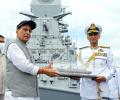
Taking a dig at China, Defence Minister Rajnath Singh on Sunday said 'some irresponsible nations' with their narrow partisan interests and hegemonic tendencies are coming up with wrong definitions of the UN Convention on the Law of the Sea.
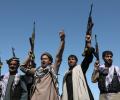
'But an overthrow of the Afghan government would really embolden regional militant groups in a big way.' 'LeT and JeM could be emboldened, and prompted to replicate in Kashmir what the Taliban did in Afghanistan.'

The athletes were unable to enter Australia due to government restrictions on foreign nationals travelling from China.

'The Andaman and Nicobar Islands are an asset that any country aspiring to become a major power would give anything to own.' 'It is disappointing that India has not capitalised on this potential,' says Vice Admiral Premvir Das (retd).

From early indications, the Modi government's foreign policy seems to be pragmatic and reciprocal, says K G Suresh.
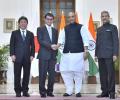
The India-Japan 2+2 dialogue added strategic heft to the special relationship in the wake of growing Chinese assertiveness on regional affairs, points out Dr Rajaram Panda.
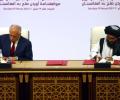
'Pakistan's trump card is that it is the only credible guarantor on the horizon who can reasonably assure the Western world that Afghanistan will not again become the revolving door for international terrorism.' 'Trust Pakistan to play this card optimally,' explains Ambassador M K Bhadrakumar.
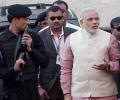
The people in charge of the PM's security need to shift the emphasis from the numerical (the number of policemen deployed) to technology-based solutions to sanitise the area where he resides, works and during his road journeys, says Anil Chowdhry, former secretary (internal security), ministry of home affairs.

Major General Sujan Singh Uban, a legendary veteran of the Second World War, was a natural choice to raise, train and command the Special Frontier Force and mould them into a well oiled fighting machine, recalls his son Inspector General Gurdip Singh Uban (retd), who led SFF troops during the Kargil War.

Even as the polity find ways and means to address the genuine concerns and fears of the society, the Sri Lankan State apparatus would have to unravel these mystery-questions with convincing answers, and a road-map to the future, says N Sathiya Moorthy.

'The worst case scenario for Pakistan is a full-scale Taliban takeover of Afghanistan.' 'Pakistani militants would be inspired and emboldened and seek to replicate the Taliban's successes in Pakistan.'

Because of the treaty, no big dams or power projects can be built by India on Jhelum, Indus or Chenab.
In the aftermath of the Easter Sunday terrorist attacks, allegations have been made that the Muslim militants in Sri Lanka draw sustenance from India. An overarching impression is being created that the ISIS is gaining ground in India, points out Ambassador M K Bhadrakumar.
India's majoritarian regime is now making a dangerously fast-paced move towards theocracy, like its western counterpart did a few decades ago, warns Mohammad Sajjad.
'China's military is expected to deploy full throttle its new equipment including J-20 stealth fighters, drones, medium range missile systems, surveillance and others to continue to put psychological pressure on India,' warns Srikanth Kondapalli, Professor in Chinese Studies, JNU.
There is a sense of relief in Beijing that Modi will be at the helm of affairs in Delhi at a critical juncture in the geopolitics of the region, says Ambassador M K Bhadrakumar.

A summary of sports events and persons who made news on Friday

'She has to get the funds, cut through bureaucratic flab, speed up modernisation, ensure planned acquisitions stick to timelines, make organisational changes and ensure the military is capable of performing the task that it is given,' says Brigadier S K Chatterjee (retd).

'We'll certainly have Hollywood productions, so why wouldn't we have Bollywood?'
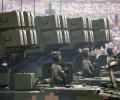
The first priority for the new Tibetan administration in Dharamsala should be to look at Tibetan recruitment in the PLA, suggests Claude Arpi.

The suspect, a 29-year-old man identified as Saifullo Saipov, of Uzbek descent, was shot in the stomach before being arrested.

'Pakistan persists in the belief that such attacks will enable it to obtain the territory it covets. Their plans will not succeed.'

FIFA President Sepp Blatter began his fifth term at the helm of football's governing body on Saturday facing the daunting task of restoring public faith in an organisation tainted by allegations of corruption and deeply divided over his re-election.

In the case of India, there are no specific references in China's white paper. However, there are several takeaways for India, says Srikanth Kondapalli.

Running highlights from FIFA's congress. World soccer's governing body has voted on a series of reforms and will elect a new president later on Friday (all times GMT): 13.30 The voting process is proving a long, drawn out affair. After an hour's voting, we have crawled to L for Latvia with little to get excited about apart from the brief appearance of Davor Suker, Golden Boot winner as the top scorer at the 1998 World Cup, as he cast Croatia's vote. Time then for a reminder that for a candidate to be elected in the first round, he must obtain at least 138 votes, two-thirds of the 207 votes cast. If this does not happen, a second round is held. This time, a simple majority -- 104 votes, which represents more than 50 percent of the votes -- is sufficient for a candidate to be elected. If no candidate gets that majority, the one with fewest votes will be eliminated and a new round will be held. This continues until one candidate obtains a majority. 12.45. Having begun his speech by promising to "die with my boots on", Sexwale ends it by withdrawing from the race, "I have got a surprise for you. My campaign ends today and I suspend my participation. With only four people it is your problem now." Markus Kattner, FIFA general secretary then reminds delegates of the voting procedure, reminding them not to photograph their ballot papers.

President Pranab Mukherjee on Monday addressed the first joint sitting of Parliament as mandatorily required under the Constitution after the general elections. The address is the political, economic and foreign policy road map of the Narendra Modi government and covers virtually all crucial areas.

News of all that's transpired on and off the football field
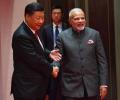
'We must compartmentalise issues, ensuring that one disagreement does not sour everything,' advises Ambassador Kishan S Rana.

Summary of sports events and persons who made news on Tuesday
